
Doyle Brunson: Texas Dolly, Super/System & WSOP Legacy
June 9, 2026
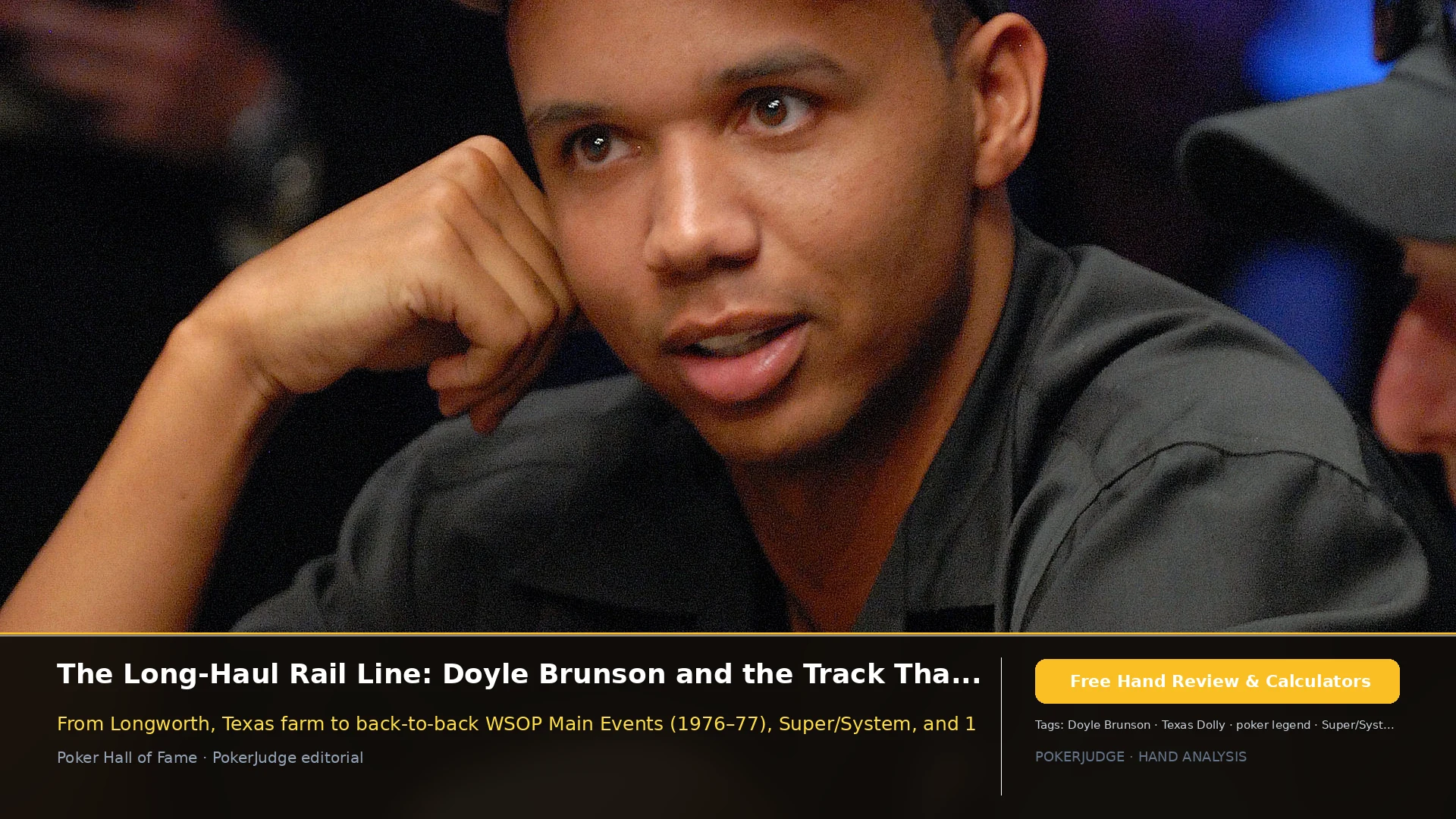
From Longworth, Texas farm to back-to-back WSOP Main Events (1976–77), Super/System, and 10 bracelets—Doyle 'Texas Dolly' Brunson laid the rail line connecting outlaw road games to the world poker runs on today.
- Doyle Brunson
- Texas Dolly
- poker legend
- Super/System
- WSOP
- poker history
- poker strategy book
- poker pioneer
Every major poker room today runs on infrastructure someone else laid down. Doyle Brunson was the engineer who drove the first through-train from Texas backrooms to Binion's Horseshoe, then kept riding that line for six decades.
Think of his career as a long-haul rail line—not a single station, but track, timetables, and rolling stock that later generations inherited.
Station 0: Longworth, Texas (1933)
Doyle Frank Brunson was born August 10, 1933, in Longworth, Texas—a farm town with no indoor plumbing. He was a serious athlete: mile runner, basketball standout, college track prospect at Hardin–Simmons University in Abilene.
A knee injury ended his basketball ambitions. The Minneapolis Lakers had shown interest; the broken leg, in Brunson's own words, destroyed a lifetime NBA dream. He graduated with a bachelor's in 1954 and a master's in administrative education in 1955, planning to become a school principal.
Poker had already paid some bills. After a seven-card stud session on his first day at Burroughs Corporation out-earned a month's salary, he left sales and went pro. The rail line's first spike went into the ground.
Station 1: Exchange Street, Fort Worth
Brunson started on Exchange Street in Fort Worth with Dwayne Hamilton, then expanded the route across Texas, Oklahoma, and Louisiana with Amarillo Slim Preston and Bryan "Sailor" Roberts. These were illegal games—often run by organized crime, with violence Brunson later described in detail. Rules were not always enforced.
They pooled bankrolls, traveled together, and gambled on poker, golf, and "just about everything." After six years they made their first serious Vegas trip and lost nearly six figures. The partnership dissolved; the friendships did not.
A 1963 cancer scare—tumor in his neck, surgery that found the cancer had spread—nearly ended the line. Brunson credited his recovery partly to prayer networks connected to his wife Louise. He used poker winnings to pay medical bills. The train kept moving.
Station 2: Las Vegas and the 1970 Inaugural Run
Brunson settled in Las Vegas and sat at the first World Series of Poker in 1970 alongside Johnny Moss, Amarillo Slim, Puggy Pearson, and the other founding passengers.
He played the Main Event nearly every year thereafter. Before his championships, he made final tables when the event was still largely winner-take-all—finishes that do not count as cashes in modern record-keeping but matter for the story.
Notable Main Event results beyond his titles:
| Year | Finish |
|---|---|
| 1972 | 3rd (famously conceded the title to Amarillo Slim for publicity reasons) |
| 1980 | Runner-up to Stu Ungar |
| 1982 | 4th |
| 1983 | 3rd |
| 1997 | 16th |
| 2004 | 53rd (field of 2,576) |
| 2013 | 409th—marking his fifth decade with a Main Event cash |
Station 3: Back-to-Back Championships (1976–77)
The defining stretch: consecutive WSOP Main Event titles.
| Year | Event | Prize |
|---|---|---|
| 1976 | $10,000 No-Limit Hold'em World Championship | $230,000 |
| 1977 | $10,000 No-Limit Hold'em World Championship | $340,000 |
Both finals ended with Brunson holding 10-2—completing full houses as an underdog. The hand is permanently nicknamed "the Doyle Brunson." (In Texas, "Doyle Brunson" can also refer to ace-queen—hands he claimed he tried never to play.)
He is one of only four players to win multiple WSOP Main Events. Only three others—Doyle Brunson, Stu Ungar, and Johnny Moss (whose 1970–71 wins included a vote-based first year)—have won consecutive Main Events.
Bluff magazine named Brunson the most influential force in poker in January 2006.
Station 4: Super/System — The Schedule Book Everyone Copied
In 1978 Brunson self-published Super/System: A Course in Power Poker. It is widely regarded as one of the most important strategy books ever written—opening professional-level thinking to recreational players.
Contributors included Bobby Baldwin, Mike Caro, David Sklansky, Chip Reese, and Joey Hawthorne. Brunson later believed publishing it cost him money at the tables because opponents learned his playbook. Super/System 2 followed in 2004.
Other titles: Poker Wisdom of a Champion, My 50 Most Memorable Hands, The Godfather of Poker (memoir, 2009).
The book was not marketing—it was the timetable that taught a generation how the train ran.
Station 5: Ten Bracelets and the WPT Extension
Brunson won 10 WSOP bracelets—tied with Johnny Chan and Erik Seidel for third all-time as of his death, behind Phil Ivey (11) and Phil Hellmuth (17).
Complete bracelet list:
| Year | Tournament | Prize |
|---|---|---|
| 1976 | $5,000 Deuce to Seven Draw | $80,250 |
| 1976 | $10,000 NLHE World Championship | $230,000 |
| 1977 | $1,000 Seven-Card Stud Split | $62,500 |
| 1977 | $10,000 NLHE World Championship | $340,000 |
| 1978 | $5,000 Seven-Card Stud | $68,000 |
| 1979 | $600 Mixed Doubles Stud (with Starla Brodie) | $4,500 |
| 1991 | $2,500 No-Limit Hold'em | $208,000 |
| 1998 | $1,500 Seven-Card Razz | $93,000 |
| 2003 | $2,000 H.O.R.S.E. | $84,080 |
| 2005 | $5,000 NLHE Shorthanded (6-max) | $367,800 |
He was the first of six players to win both a WSOP Main Event and a World Poker Tour title—taking the 2004 Legends of Poker WPT for $1.1 million. He was also the first player to win $1 million in tournament poker.
Live tournament earnings exceeded $6.1 million lifetime; over $3 million came from WSOP cashes alone.
Side Tracks: Family, Business, and Later Runs
Personal life: Married Louise in August 1962. Their daughter Doyla died at 18 from a heart-valve condition. Son Todd Brunson won a 2005 WSOP bracelet in $2,500 Omaha Hi-Lo—the first father–son bracelet pair in WSOP history.
Doyles Room: Online poker room (2004–2011) that changed networks several times; seized in a 2011 gambling investigation; acquired by Americas Cardroom in October 2011. Brunson cut ties after April 15, 2011 ("Black Friday").
WPT bid (2005): SEC investigated an unsolicited offer to buy WPT Enterprises; stock spiked then collapsed when Brunson withdrew. Case dropped in 2007.
Retirement announcement: June 11, 2018—then entered the $10,000 2–7 Single Draw at that year's WSOP and finished 6th for $43,963. He briefly returned for the 2021 WSOP Master of Ceremonies Invitational (5th place).
Last Stop: May 14, 2023
Doyle Brunson died in Las Vegas on May 14, 2023, aged 89. A Celebration of Life at the 2023 WSOP featured tributes from Daniel Negreanu, Phil Hellmuth, and others.
Daniel Negreanu once called him "the bridge between history and today." That is the rail metaphor made literal: Brunson connected outlaw Texas gambling to televised WSOP, strategy literature, and the professional ecosystem every serious player now inhabits.
What the Line Still Carries
You do not need to play like Doyle Brunson in 2026 to benefit from his track:
- Road-game discipline — bankroll survival through variance and violence
- Public legitimacy — choosing to win Main Events when hiding was still profitable
- Open-source strategy — Super/System democratized pro thinking decades before solvers
- Longevity — five decades of Main Event cashes, high-stakes cash games in Bobby's Room, and a retirement that wasn't
The 10-2 hand is folklore. The rail line is infrastructure. Every player who opens a solver, watches a WSOP stream, or reads a strategy article is riding a route Brunson helped build—whether they know the engineer's name or not.