
QJT7 with 98: Rank the Straight Before You Bet It
July 5, 2026
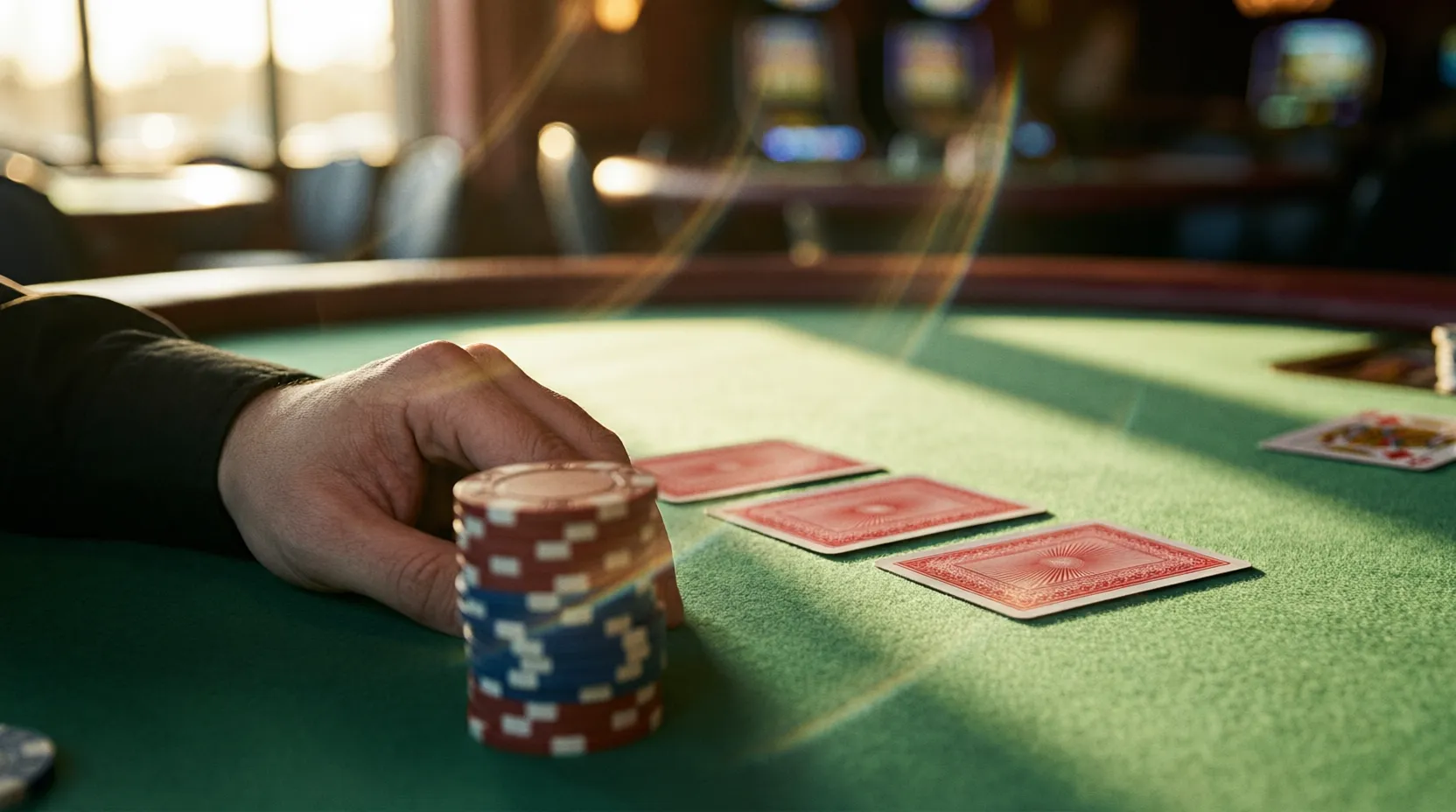
On Q♦J♣7♣T♠ you hold an understraight, not a license to build the pot. Rank who beats you, what the flop check-call still means, and why checking behind at SPR≈2 is usually the adult line.
- ["3-bet pot"
- "deep stack"
- "understraight"
- "turn check"
- "reverse implied odds"
- "SPR"
- "pot control"]
"I made a straight" is not a line. It is a label. On Q♦ J♣ 7♣ T♠ with 9♣8♣, that label is the bottom straight on the board—and deep in a 3-bet pot, bottom straights behave like liabilities with showdown value, not like stack-off monsters. Upswing's reverse-implied-odds framing is the right mental model: the same cards that "complete" you also complete better hands, and deep money amplifies the bill.
This piece is a turn fork after the out-of-position aggressor checks. No FAQ pad. No fake solver mix to three decimals.
The Spot (Numbers You Can Audit)
$2/$5 cash, 200bb effective. UTG opens to 4bb; MP calls; Hero on the button 3-bets to 16bb with 9♣8♣; UTG calls, MP folds.
Rough pot ≈ 37–38bb, ~184bb behind.
Flop Q♦ J♣ 7♣. UTG checks. Hero bets ~22bb; UTG calls. Pot ≈ 81bb, ~162bb behind → SPR ≈ 2.
Turn T♠. Board: Q♦ J♣ 7♣ T♠. UTG checks again. Hero's decision.
Preflop note, said once: 98s as a button 3-bet into an UTG open with a cold-caller already in is a light, coverage-style squeeze—not a default chart hand. The postflop problem is still worth studying because the board class shows up whenever suited connectors get there.
First Fix the Hand Class
Old writeups of this hand called the flop an "open-ender." That is wrong.
On Q-J-7 with 9-8 you have:
- a gutshot to the Ten (makes 8-9-T-J-Q), and
- a club flush draw (two clubs on board, two in hand).
That is a real combo draw. It is not OESD. An Eight does not "complete" anything new—you already hold one. Getting the classification right matters because it changes how you describe equity and how you talk about the turn "arrival."
On the Ten, you do arrive: 8-9-T-J-Q, a Queen-high straight. Not "9-high." The nine is one of your hole cards; the straight's top card is the Queen.
Straight Ladder on This Exact Board
Before you reach for chips, order the made straights:
| Rank | Holding | Straight |
|---|---|---|
| Nuts | A-K | A-K-Q-J-T (Broadway) |
| Second | K-9 | K-Q-J-T-9 |
| Third (you) | 9-8 | Q-J-T-9-8 |
Sets (QQ / JJ / TT / 77) are behind the straight on this unpaired turn. Two pair is behind. Overpairs are behind. The disaster bin is higher straights, then boats when the board pairs, then flushes when a club rivers.
Your 9♣ blocks some K9 and some club combos. It blocks zero Ace-King. ThinkGTO / Upswing-style reverse-implied-odds notes keep repeating the same warning for low-end straights: you win small pots when ahead and lose large ones when dominated. That is the deep-stack tax.
What the Flop Call Still Means
UTG opened early, called a button 3-bet out of position, then peeled a sizable flop bet on a wet Broadway texture. That path is not "any two."
Surviving mass tends to cluster toward:
- Broadway value that likes Q/J (AQ, KQ, QJ-type hands),
- overpairs that flat rather than 4-bet every time,
- sets,
- AK that was a draw and is now the nuts,
- some suited club equity and gutshot wraps that still want a price.
GTO Wizard's turn-in-3-bet-pot notes (barreling and OOP turn play) keep circling one theme: when the nut advantage is contested or belongs to the caller, checking rises and polarization tightens. You are the in-position 3-bettor who just got there with the worst straight. You do not suddenly own the nut advantage because the Ten completed your gutshot.
The check-to is not a gift certificate. At SPR ≈ 2, a bet turns the node into "call or face a raise that prices you into a fold-or-stack decision with a hand that loses to the natural raise bin."
Liability Ledger (Not a Solver Screenshot)
Split the turn into three bins. Frequencies are directional—not invented mix percentages.
1. Hands that stack you if money goes in big AK (and K9 you did not block). Raise-heavy lines here are rarely "light" in a deep 3-bet pot on a four-straight board. If you bet and they jam, your equity against a value-heavy raise range is often too thin to continue—even when pot odds look "only" around one-third. The original arithmetic direction is fine; the precision theater is not. Folding a straight feels sick; calling off 160bb dominated feels worse.
2. Hands that pay a bet once Strong one-pair, some two-pair, stubborn overpairs. These are your actual value targets. They shrink fast if you choose a large size that looks like the nuts.
3. Hands that use your bet as a bluff-raise candidate Against loose-aggressive opponents who float wet flops, your stab can become the chip they needed to turn a leftover draw or a pair+gs into a shove. PokerStrategy-style deep-stack notes and Upswing's deep-stack adjustments both push the same caution: pot control beats "protection theater" when reverse implied odds are large.
If bin 1 and bin 3 are live, betting is not "taking value." It is volunteering for the worst node your hand can face.
The Adult Line: Check Behind by Default
In position, checking behind does three concrete jobs:
- Caps the disaster. You refuse the check-raise off the understraight.
- Keeps showdown paths open. Many one-pair hands still stab rivers; your disguised straight is a fine caller on blanks.
- Matches the incentive shape solvers describe for non-nut advantage turns. GTO Wizard's deep 3-bet turn pieces emphasize more checking / smaller sizes when nuts are contested; RiverOdds' 3-bet postflop heuristics treat medium made hands at higher SPR as pot-control candidates, not auto-commit hands. An understraight is "medium" here in the only sense that matters: it is not the nuts and hates raises.
You do give free cards. On this turn the scary free cards are mostly:
- clubs (flush > your straight; your own flush is only nine-high),
- board-pairing cards (sets → boats),
- Ace / King (Ace makes Broadway for AK already ahead; King upgrades K9 and also gives you K-Q-J-T-9—but AK still has Broadway and wins).
That list is real. It is still usually cheaper than building a pot where AK check-raises you off the third-nut straight.
When a Small Bet Is Still Fine
Check-back is the default, not a religion.
Bet small (think ¼–⅓ pot, not geometric stack-off sizing) when most of these are true:
- Villain almost never check-raises without the nuts / boats,
- Their flop-call range still contains plenty of one-pair that will peel once,
- You are happy folding to a raise (and will actually do it),
- You are not trying to "get it in" with Q-high.
Against a true calling station, the small stab taxes the bin-2 hands and rarely invents bin-3. Against a XR-happy LAG, the same stab is how you donate.
If you bet larger to "deny equity," ask whether the hands you deny are drawing live and whether the price of denial is a raise you cannot continue against. With an understraight, denial is often overpriced.
River Map After the Check
Assume turn checks through. Pot still ≈ 81bb; stacks still deep enough to hurt.
Blank / low brick. If they bet medium, calling is the standard use of a disguised straight. If they check, a modest value bet is reasonable—target one-pair, not phantoms.
Club. Flush completes. Your straight drops a tier; your flush, if you make it, is vulnerable. Prefer caution versus large aggression. Small stabs from chronic bluffers can still be looked up; do not invent hero calls against overbet energy.
Pairing card (Q/J/T/7). Sets that were behind become boats. Your "I have a straight" story dies. Default to check-evaluate; folding to heavy heat is allowed and often correct.
Ace. AK already had you crushed; the Ace is not your friend. King is dual-edged as above—do not auto-stack just because you "improved."
What This Hand Is Teaching
The lesson is not "never bet straights." It is:
- Rank the straight on the actual board before you pick a size.
- Name the draw class honestly on earlier streets (gutshot + FD ≠ OESD).
- At SPR ≈ 2 in a deep 3-bet pot, an understraight's best job is often surviving to river with disguise, not polarizing into a raise.
If your review filter only celebrates "I hit and bet," this board class will keep taxing you. Mark the hands where you held the third-best straight and still felt obligated to build the pot—that obligation is the leak.