
Is All-in Britney Really About to Collapse?
October 1, 2026
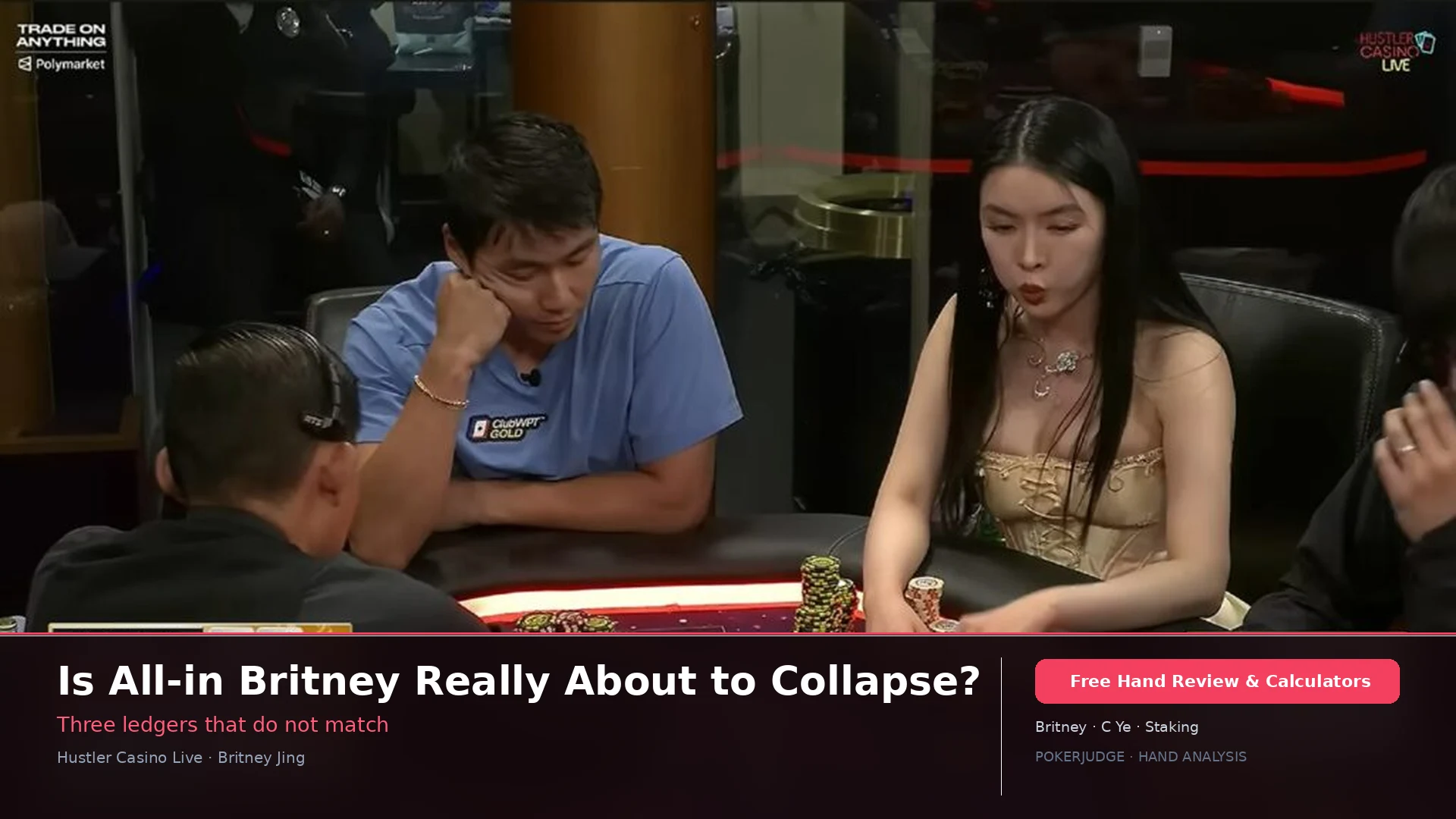
A $18,000 debt dispute between C Ye and HCL regular Britney Jing reveals illegal same-table staking, hidden private-game profits, and AML scrutiny, exposing the dark side of high-stakes live poker.
- live poker controversy
- Hustler Casino Live
- Britney Jing
- C Ye
- staking violation
- AML compliance
- poker private game
- poker integrity
On September 21, 2026, Chinese-American poker player C Ye (Xi Ye) posted a callout video on YouTube: She Ghosted Me After Owing Me Money.... The target of the debt collection was Britney Jing (Wang Yijing), a high-frequency regular on Hustler Casino Live (HCL) and the so-called “All‑in Sister.” The disputed amount was only $18,000. On HCL’s high-stakes live stream tables, that number is not even enough for Britney to blind-jam a straddle. But this trivial remainder sliced open one of the murkiest corners of North America’s high-stakes Chinese poker scene like a scalpel: prohibited same-table staking, concealed profits and losses in private games, money-laundering compliance scrutiny, and a carefully packaged “female poker goddess” persona.
This is not a dispute over one debt. It is three sets of books that do not reconcile at all.
Book One: The On-Camera “Persona” and the Distorted Curve
On social media, Britney’s labels are “professional poker player” and “Web3 investor.” She excels at traffic-driven storytelling: posting photos with Curry and Butler, posting her scorecard from Westbrook’s charity game, and in 2024 even being crowned by some Chinese-language media as “HCL’s biggest female winner.”
But according to third-party public tracking data from Highroll Poker, her live-stream ledger has suffered a brutal cliff:
| Stage / Metric | Data Presentation | Core Characteristics and Context |
|---|---|---|
| Peak (June 2024) | Ledger around +$900,000 | Extremely loose playing style, decisive jams, molded into a representative Chinese female winner |
| Decline (through September 2026) | 198 sessions / 972 hours, net loss around -$241,000 | Hourly rate turned negative, extreme volatility, frequent failures on deep-stack blind jams |
| Off-table compliance (June 5, 2026) | WSOP Paris Hotel $100/$200 live-stream table; after losing nearly $100K in the first two hours, she was forcibly removed by casino compliance | Buy-in funding sources were brought onto the table for scrutiny |
The June 5 removal was a watershed. At the time, Caesars’ compliance team intervened to investigate the source of buy-in funds (AML). Although Britney explained that the funds came from blackjack winnings at MGM, and HCL co-founder Ryan Feldman publicly explained it as an internal casino communication breakdown, the scene shattered the underlying illusion of high-stakes tables: behind six-figure stacks, the legality of the money began to be examined under the spotlight.
Book Two: Explicitly Prohibited Action Rewrote the Table’s Win Rates
In high-stakes circles, spreading risk through staking / action is normal, but on live-stream tables, cross-buying shares among players at the same table is universally recognized as a capital offense. HCL’s participation agreement states the uncrossable red line in bold:
Player will not engage in any form of 'percent staking' with any other person participating in the Events.
The reason is simple: nine players competing individually is a game; if two of them privately share 30% of profits and losses, the table’s incentive structure instantly becomes distorted. Even without collusion, their pot odds, protection strategies, and incentives to apply pressure can never remain equivalent.
But the two players’ arrangement stepped directly over that red line:
- Private revenue split: In March 2026, Britney proposed via FaceTime to buy 30% of C Ye’s action in all future games, covering both live-streamed games and private games.
- Same-table competition: The April 2 Ante Game replay showed that the two were already seated at the same table.
- Funds settled: Within three months, C Ye performed strongly (live-stream tracking around +$434K), and Britney took about $140K in profit. Then in June, C Ye lost $60K net in one game; at 30%, Britney owed $18,000 for the loss.
This is exactly the source of the internet-wide public opinion war.
Book Three: The Venetian Without Cameras and the Rashomon of Vanishing Chips
The $18,000 should have been settled on the spot, but the accounts completely collapsed on June 7 at a private, non-live-streamed game at the Venetian. Britney’s reason for refusing to settle the $18,000 was not that she could not pay, but that she accused C Ye of concealing his true winnings in that private game.
Britney’s allegation logic:
- Private game ends: About an $80K chip shortfall appeared on the table.
- Reported discrepancy: C Ye reported winning $190K; but sober players at the table said his actual profit was close to $280K.
- Reverse calculation: If the $80K underreporting is true, the 30% split should be $24K.
- Conclusion: $24K (additional profit share owed) − $18K (loss share owed) = C Ye owes $6,000 instead.
The confrontation between the two sides then descended into a classic poker-circle cold case:
- C Ye’s counterattack: He insisted he had not underreported, vowed, “If it is proven I underreported, I will pay 100x or even 1000x,” and pointed out that Britney was at the same table and could see the chips.
- Britney’s counterattack: She struck directly at the pain point of private games — “This one happened to have no surveillance footage.” She said Venetian security had revealed that C Ye’s chips far exceeded $200K, but that complete surveillance could not be obtained because of warnings about casino legal exposure.
- Peripheral voices tearing at each other: Poker player Xuan Liu (Xuan Liu) posted a video discussing details of the security investigation; Jeff the Cash and Wesley (Dr.Hash) and others successively threw out more serious allegations such as “chips stolen off the table (ratholing)” and “multiple parties buying shares to hunt the whale,” but none produced a verified audit.
In this melee, handwritten apology letters, sending flowers, buying bags, and leaking private relationship gossip quickly filled the spectator appetite of the Chinese-language community. But stripping away these soap-opera subplots, the essence of high-stakes gambling is only arithmetic and honor.
Repricing
When players buy action in private games without third-party notarization, they are essentially trading credit futures. Once mutual trust breaks down, the system immediately exposes its most fatal structural flaw: if you win, you split the money (with ledger evidence); if you lose, you refuse to acknowledge it (insisting the private game was concealed). This degenerates into a zero-risk freeroll.
$18,000 truly cannot crush a famous player with two hundred on-camera sessions. But this long-distance mutual tearing-open thoroughly exposed the coarse reality behind the glossy curtain of the high-stakes live-stream scene: same-table agreements knowingly made in violation of the rules, private-game messes that cannot be reconciled without footage, and a fragile persona that packages traffic photos into competitive dominance.
A persona can still keep sitting at the table with filters and PR, but in the real ledger, that face has already quietly had its credit score deducted.